Console Tables in Singapore: Surviving Humidity, Heat and HDB Corridors
I delivered a 1.5 m walnut console table to a fourth-floor walk-up in Bedok last month. The lift opening measured 80 cm wide by 210 cm deep — the box would not fit standing up. We tipped it on its side, protected the edge with 12 mm felt, and it slid through. The customer laughed and said, "I didn't think a piece of wood could be the hardest part of moving day." That single delivery captures the entire reality of buying a console table in Singapore: humidity, heat, narrow HDB lift doors, and the daily microclimate of a tropical home.
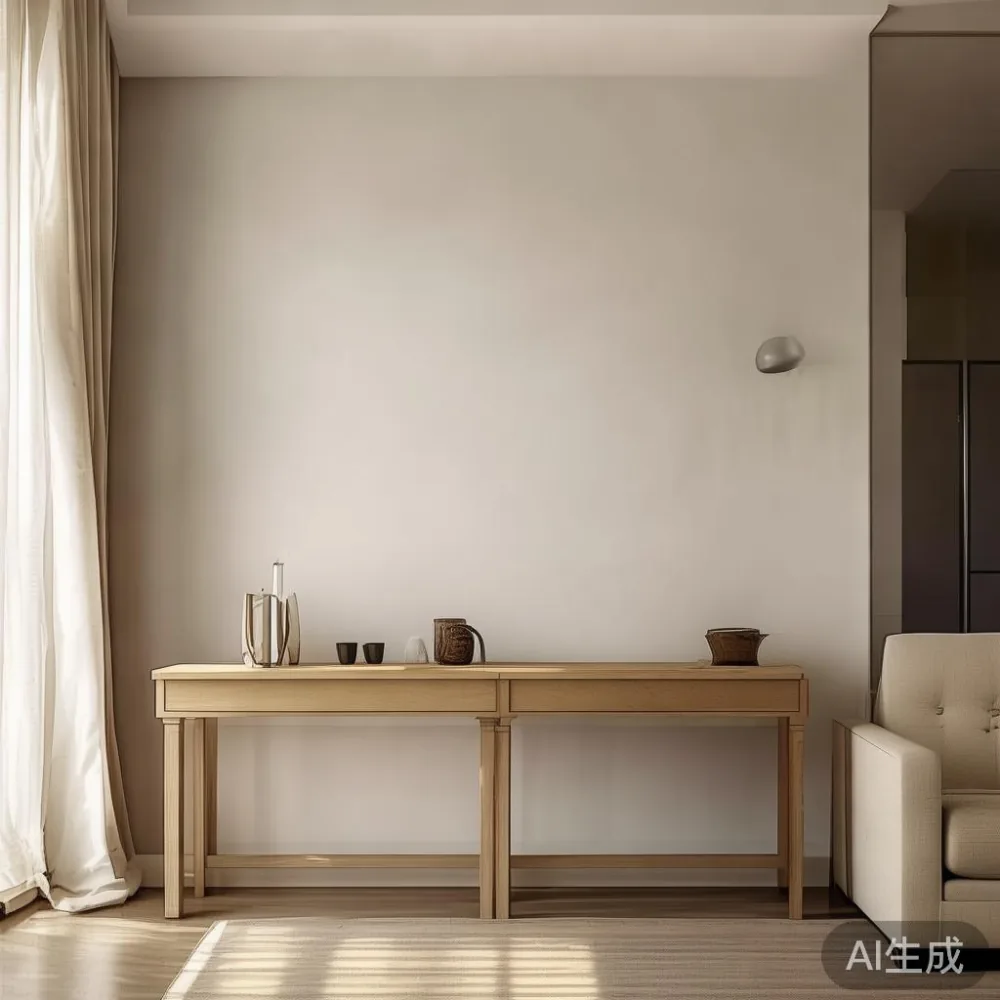
Below is what I have learned over more than a decade of shipping solid wood furniture into Tampines, Bedok and Punggol HDB flats and private condos, and how MIDHILL approaches each of these constraints when building pieces for the Singapore market.
Why Singapore's climate is unusually aggressive on solid wood
Singapore sits roughly one degree north of the equator. Outdoor relative humidity stays between 65 % and 95 % for most of the year, and indoor humidity in a non-air-conditioned HDB flat can swing from 55 % at midday to 82 % at 3 a.m. A solid wood console table is a hygroscopic object — it absorbs and releases moisture every hour. When the wood's moisture content (MC) climbs above 12 %, you start to see raised grain, sticky drawers, and joints that no longer sit flush. When the room plunges under sustained air-conditioning at 22 °C with 45 % RH, the same panel can shrink 1–2 mm across its width overnight.
The issue is not the heat. It is the swing. Wood prefers stability, not perfection. A piece that is built at 8–10 % MC and then placed in a stable 55–60 % RH room will sit quietly for years. A piece that was rushed through a dryer, or built from poorly acclimated stock, will move constantly. I have measured 4 mm of seasonal expansion on a poorly made 1.8 m console table top in a Punggol condo — enough to crack a marble insert or pop a mitred edge.
How much does a nightstand cost in Singapore?
A solid wood nightstand in Singapore typically costs between SGD 380 and SGD 1,450, with the most common range sitting around SGD 550–SGD 850 for an oak, ash or walnut two-drawer unit about 45–55 cm wide, 40–45 cm deep, and 55–60 cm tall. The wide spread comes down to three things: species (walnut commands roughly 35 % more than rubberwood), joinery (mortise-and-tenon drawers cost more than dowelled or stapled frames), and whether the top is a single solid slab or a glued-up panel. At MIDHILL, our equivalent nightstand sits at SGD 720 with a 10-year structural warranty, and we ship free above SGD 350.
For buyers comparing a nightstand to a console table, the rule is simple: budget per kilogram. A solid wood nightstand weighs 18–28 kg depending on size; a 1.4 m console table weighs 35–55 kg. If the price-per-kg of the nightstand feels fair, the console table at the same rate should feel fair too.
Corridor geometry, lift doors, and the 78 cm problem
The single biggest surprise for overseas furniture brands exporting to Singapore is the lift. A standard HDB passenger lift has an internal cabin roughly 1.1 m deep by 1.4 m wide, with a door opening of about 78–82 cm wide and 200–210 cm tall. A 1.6 m console table simply will not fit standing up. Even a 1.2 m piece, on its side, needs careful planning.
Three practical rules I now apply to every Singapore-bound order:
- Console table length: keep the main run under 1.5 m so the piece can be tipped onto its long edge for lift access.
- Console table depth: stay under 38 cm if the piece has to pass through a 78 cm door opening diagonally.
- Detachable legs: any console table taller than 70 cm should ship with bolt-on legs, not glued or welded frames, so the top can be removed and carried flat.
Corridor widths in older HDB blocks such as those in parts of Bedok and Toa Payoh can dip to 110 cm at the tightest turn. A 1.5 m console table on its side takes about 80 cm of corridor width when you account for the 5 cm buffer each side. Do the maths before you fall in love with a 2 m version.
The real enemy: how humidity attacks joints, panels and finishes
There are four failure modes I see repeatedly in Singaporean homes, and each one has a specific cause.
1. Cupped table tops. A solid wood panel wider than 60 cm wants to cup when humidity changes. The fix is quartersawn stock for the top, breadboard ends, or a plywood substrate faced with solid veneer. Avoid a console table with a top made from flat-sawn boards glued side-by-side without restraint bars — it will cup within six months.
2. Stuck or loose drawers. Drawer fronts move more than drawer sides. A 40 cm drawer front in an unconditioned flat can grow 1.5 mm in width during the wet season and shrink the same amount in a dry-air-conditioned bedroom. Quality makers cut a 1.5 mm clearance on each side and finish the slider with wax. Cheap makers cut zero clearance and the drawer locks by July.
3. Cracked mitres and opened glue lines. Polyurethane (PU) glue is rigid once cured. When wood moves, the glue does not. White PVA or hide glue moves with the wood and forgives small dimensional shifts. For console table aprons and door frames, ask the maker what glue they use. If the answer is "industrial yellow glue," it is PVA — that is good. If it is "super glue" or "epoxy," the joints will crack in a tropical climate.
4. Cloudy or milky lacquer. High-gloss PU finishes blush (turn milky white) when moisture gets trapped under the film during application. The blush never fully disappears. It is a maker-side problem, but a buyer can spot it by running a finger across the surface in raking light — a blushed panel will feel ever-so-slightly tacky or waxy for the first six months.
Which woods actually survive a Tampines HDB flat?
After 15-plus years of exporting to the region, my shortlist for Singaporean console tables has narrowed to five species. I have ranked them by stability, then by availability, then by colour suitability for French light luxury and post-modern light luxury interiors.
White oak (Quercus alba). The benchmark. Janka hardness 1,360, MC movement coefficient about 1.8 % tangential. Takes a hand-rubbed oil finish beautifully. Sits naturally inside American light luxury schemes with linen, brushed brass and boucle upholstery on a matching solid wood sofa.
European ash (Fraxinus excelsior). Slightly softer (Janka 1,320) but more elastic, which actually helps in high-humidity environments because ash bends before it breaks. Pale cream colour that pairs well with sintered stone and marble — the same direction an Italian light luxury sintered stone care sofa tends to push visually.
Teak (Tectona grandis). Native to the region, naturally oily, and the most dimensionally stable option on this list. Heavier — a 1.4 m console table in teak can weigh 48 kg versus 38 kg in oak. Worth it for ground-floor condos near the coast where humidity peaks at 88 %.
American walnut (Juglans nigra). Beautiful chocolate tone, but a Janka of only 1,010 and a movement coefficient near 2.3 % tangential. In a Singaporean bedroom running an air-conditioner 14 hours a day, expect a 2 mm seasonal shift on a 1.5 m console table top. Choose quartersawn stock and accept the premium.
Rubberwood (Hevea brasiliensis). Underrated. Janka 995, but when properly kiln-dried to 8–10 % MC and used in smaller console table formats (under 1.2 m), it performs within 10 % of ash at half the price. The honest budget choice.
What to avoid: any "solid wood" piece that turns out to be MDF with a 0.5 mm veneer. MDF absorbs humidity like a sponge and swells irreversibly. Pressed at the edge, you can sometimes feel the difference — MDF cuts powdery, solid wood cuts fibrous.
Finishes, air-conditioners and the 12-month acclimatisation window
A console table arriving in Singapore has usually been built and finished in a Foshan workshop where ambient humidity sits around 70–80 % RH — almost identical to Singapore. The bigger swing is inside the customer's home. Two habits matter more than any finish choice:
Keep the room between 22 °C and 26 °C with RH between 50 % and 65 %. A SGD 60 hygrometer from HomeFix or a SGD 25 digital unit from Taobao makes this measurable rather than guessed.
Avoid placing a solid wood console table directly against an external HDB wall. The wall surface can run 4–5 °C cooler than room air during a wet-phase monsoon, which means condensation forms on the back of the piece and the wood absorbs it preferentially. Leave a 5 cm gap behind the piece, or place it against an internal partition.
For the finish itself, hardwax oil (Osmo, Rubio Monocoat) outperforms polyurethane in this climate because it is microporous — moisture can leave the wood through the finish rather than being trapped under it. The trade-off is lower scratch resistance, so a console table in a corridor with heavy foot traffic benefits from a wax-only maintenance coat every 12 months.
Expect a 12-month acclimatisation window. A new console table will move slightly for its first year as it finds equilibrium with your specific home. After that, the seasonal movement becomes small and predictable. Buyers who panic at month three and shove the piece back into a more humid room often make the problem worse.
Maintenance schedule that actually works for a Singaporean console table
Once a quarter, wipe the surface with a barely damp microfibre cloth, then dry it. Once every six months, apply a thin coat of paste wax (Renaissance Wax is the standard) and buff after 20 minutes. Once a year, inspect the underside for mildew — common on pieces placed too close to an external wall. Once every three to five years, lightly sand the top with 320-grit and re-oil.
For the matching dining table and bed frame in the same household, the schedule is identical. For a wardrobe or nightstand that lives in an air-conditioned bedroom, drop the waxing to once a year because the wood moves less. For an open-plan living-dining console table that fronts a kitchen, expect grease and water marks — keep a coaster rule and the finish will hold for a decade.
Reading a product page before you click "add to cart"
Three spec lines tell you almost everything about how a console table will behave in your flat. First, the listed moisture content at shipping — anything between 8 % and 10 % is acceptable; anything above 12 % is a red flag. Second, the joinery description: mortise-and-tenon, dovetail, or dowel are all acceptable; "screwed" or "stapled" alone is not. Third, the finish type: hardwax oil, PU lacquer, or nitrocellulose lacquer — all fine, but know which one you are buying so you can maintain it correctly.
Weight is also a useful proxy. A 1.4 m solid wood console table should weigh between 32 kg and 55 kg depending on species. If the listing says 18 kg, it is not solid. If it says 70 kg, it is probably teak or includes a marble top — both legitimate, just different price brackets.
Returns, warranty and the small print that matters in Singapore
Local consumer law gives Singapore buyers a baseline of protection, but the maker's own policy usually goes further. MIDHILL offers a 14-day return window, a 10-year structural warranty, lifetime refinishing on solid wood pieces, and free shipping on orders above SGD 350. For a console table that costs SGD 1,100, that means the unit arrives at your door with no hidden delivery fee, and if a joint loosens in year eight, the fix is on the maker — not on your wallet. Worth checking the equivalent terms on whichever brand you end up choosing.
Why this matters beyond the console table
A console table is often the entry point into solid wood furniture for a Singaporean household. Once the piece holds up through two monsoons and a Lunar New Year reunion dinner, the same customer comes back for a dining table, a bed frame, a wardrobe, a nightstand, or a marble-topped centre table for the living room. Choosing the right console table — at the right moisture content, in the right species, with the right joinery — sets the standard for everything that follows. Done well, the first piece is the one you are still using in 2035.