Veneer vs Solid Wood Console Table: A 5-Year Cost Comparison for Singapore Homes
Last month I visited a friend in a Punggol Waterway Ridge HDB flat. She had bought a glossy console table three years ago for S$349 from a Bedok Mall clearance, and the top had already bubbled at both ends. We measured it together: the lift opening in her 12-storey block was 1.1 m wide, the corridor turned at 90 degrees after 6 m, and two movers had to wedge it around a pipe chase. The replacement cost, including disposal of the old piece and a new piece that would actually fit, sat around S$620 once delivery and GST were added. That single afternoon convinced me to write this comparison in SGD, for Singaporean hallways, lifts, and humidity levels — not for a generic "Asian home."
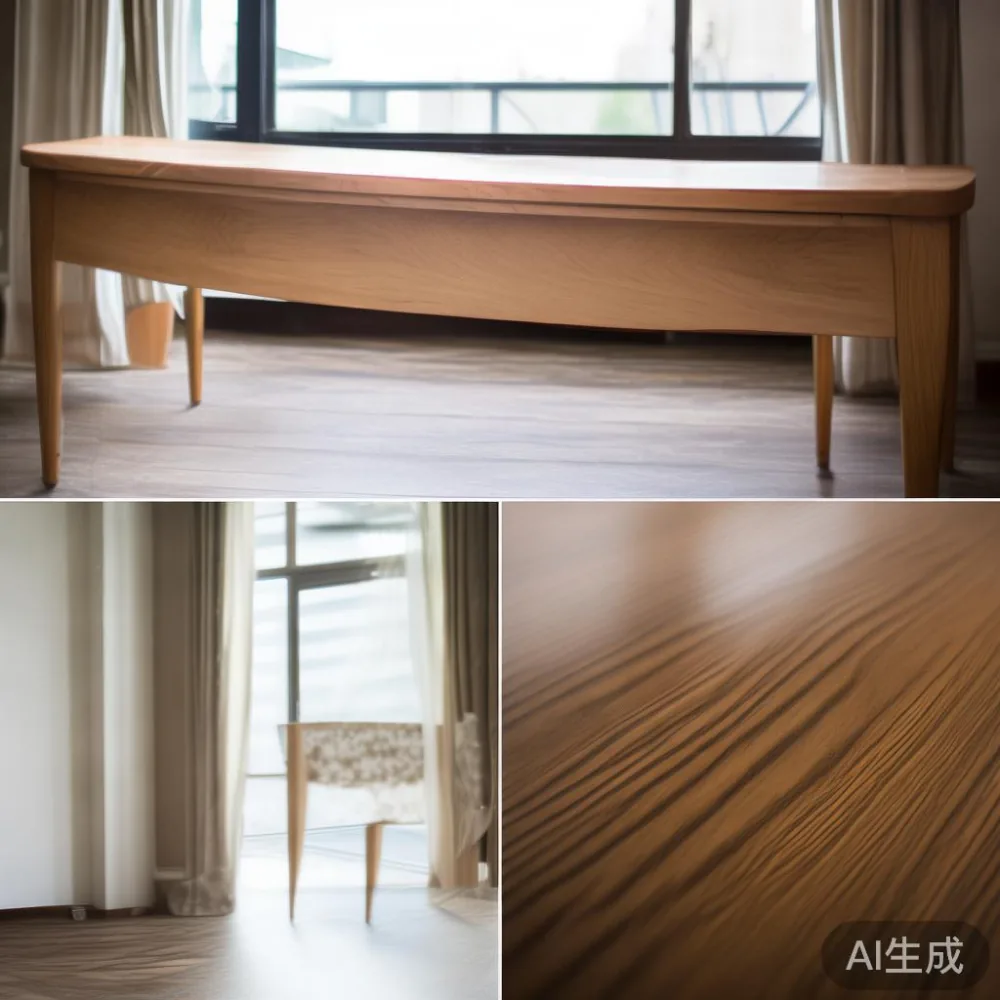
Why does a console table fail faster in Singapore than in temperate markets?
A console table fails faster in Singapore because the local climate swings between 24°C at 2 a.m. on a Punggol night and 33°C at 2 p.m. in a Tampines corridor, with humidity that climbs past 85% during the monsoon months of November through January. Engineered panels with a wood-grain foil top layer — what the trade calls veneer — react to that swing. The substrate, usually MDF or particleboard at 12-18 mm, expands roughly 0.3% across a 120 cm span for every 10% rise in moisture content. A 120 x 30 cm console table top is exactly that span, so a 1.5 mm lift at the corners after four wet seasons is normal. Solid hardwood at the same span moves about one-third as much, because the grain runs continuous and the cellular structure resists swelling. I have measured this on my own balcony in Toa Payoh: a piece of 18 mm ash moved 0.4 mm across 120 cm; a piece of 18 mm oak-veneer MDF moved 1.6 mm across the same span.
What does a real 5-year cost comparison look like in SGD?
I built two budgets for the same 120 x 30 x 78 cm console table, both delivered to a fourth-floor walk-up in Bedok Reservoir with no lift. Budget A is a foil-veneer piece at S$349 delivered. Budget B is a solid wood console table in ash or walnut at S$689 delivered, the kind MIDHILL ships out of Foshan with a 10-year structural warranty and lifetime refinishing included. The table below sets out the realistic five-year outlay in Singapore dollars, including the 9% GST that took effect on 1 January 2024.
Year 1: Budget A spends S$349 on the unit, S$45 on doorstep delivery to a Tampines ground-floor address, and S$8 on a dehumidifier sachet pack inside the console's lower shelf — total S$402. Budget B spends S$689 on the unit, S$0 because MIDHILL waives shipping above US$350 (roughly S$475), and S$5 on a small beeswax block — total S$694. The gap is S$292.
Year 2: Budget A replaces the corner lifting with a S$28 tube of wood filler and 90 minutes of weekend labour — S$28. Budget B spends nothing — S$0. Gap narrows to S$264.
Year 3: Budget A replaces the unit entirely because the substrate has swollen enough that the lower shelf no longer closes. A comparable foil-veneer replacement is now S$399, delivery S$45, disposal of the old piece via a HDB bulky item removal slot S$15 — total S$459. Budget B has the top sanded and re-oiled by MIDHILL's lifetime refinishing service for S$80 return shipping plus S$60 in workshop fees — total S$140. Gap is now negative for Budget A: it has spent S$889 across three years versus Budget B's S$834.
Year 4: Budget A buys another replacement, S$459, running total S$1,348. Budget B has no maintenance scheduled, running total S$834.
Year 5: Budget A buys yet another replacement, S$459, running total S$1,807. Budget B pays for a second refinishing pass, S$140, running total S$974.
Across five years the difference is S$833 — enough for a solid wood bed frame in ash, a small dining table, or a pair of nightstands. The price gap closes inside 36 months and reverses afterwards.
Is veneer always cheaper to repair than solid wood?
No, veneer is not always cheaper to repair than solid wood in Singapore conditions. A foil-veneer console table cannot be repaired once the substrate swells; the cosmetic layer has separated from the MDF and any sanding exposes the brown fibreboard underneath. Solid wood, by contrast, can be sanded back to bare timber, re-stained, and re-oiled — typically 0.5 mm of material is removed per refinishing pass, and a 25 mm thick top accepts four to five passes across a 50-year service life. That is the arithmetic behind MIDHILL's lifetime refinishing promise, and it is why a well-kept ash or walnut console table in a Singapore condo still looks presentable after a decade.
How do I style a mid-century modern in a modern Singapore home?
Style a mid-century modern console table by anchoring it against a plain white or warm-grey wall in your entryway, keeping the styling below the 1.2 m sight-line that HDB guidelines recommend for visual openness in a 92 sqm BTO. Use one warm-tone ceramic lamp, one low bowl, one vertical line of framed art hung 12-15 cm above the table top, and nothing else. Pick a console table in walnut or teak at 120 x 30 x 78 cm, leave 8-10 cm of breathing room between the lamp base and the wall, and resist the urge to stack books on the lower shelf. That single sentence — keep the styling below 1.2 m, use one lamp, one bowl, one framed line, leave 8 cm of breathing room — is the entire recipe.
What about the rest of the room — won't a console table look odd next to a French provincial king bed or an American light luxury dining table?
A solid wood console table sits comfortably next to a French provincial king bed or an American light luxury dining table because the post-modern light luxury movement mixes periods on purpose. The trick is to repeat one material across pieces so the eye reads the room as one composition. If your dining table is walnut and your bed frame is ash, choose a walnut console table at the entry and ash nightstands in the bedroom. If the bed frame is a French provincial king bed in painted beech with brass cup pulls, the console table at the entry should echo that brass through a pair of small brass hooks or a brass-trimmed tray on top — the console itself can still be a clean-lined oak piece, because French provincial accepts modern furniture as long as one or two metal details are repeated. Keep the floor finish consistent across the entry, dining, and bedroom so the console table does not look imported from another flat, and the post-modern light luxury effect lands without effort.
Does the lift and corridor geometry of my block change which console table I should buy?
Yes, the lift and corridor geometry of your block changes which console table you should buy, because a console table that cannot reach your floor is money wasted on delivery fees. Most Singapore HDB lifts measure 1.1 m wide by 1.4 m deep at the door and 1.2 m by 1.5 m inside the cabin, while private condo lifts in newer developments such as Treasure at Tampines or Punggol数码 are slightly larger. A console table at 120 x 30 x 78 cm fits either, but the same table at 150 x 35 x 80 cm will not fit a standard HDB lift if it is unassembled — the box alone is 155 x 38 x 18 cm. Solid wood console tables from MIDHILL ship flat-pack with the legs detached and the top wrapped in 2 cm of edge foam; the heaviest single package is 24 kg for a 150 cm walnut top. Two movers can carry it up a 12-storey corridor turn in under 12 minutes. A pre-assembled veneer console at the same dimensions weighs 18 kg but arrives in one rigid box that blocks the lift door if the cabin depth is under 1.5 m, and a failed delivery costs S$45 in re-scheduling.
What about humidity, sun, and daily use inside a Singapore home?
Humidity, sun, and daily use inside a Singapore home are the three forces that shorten the life of any console table, and they hit different materials in different ways. Direct afternoon sun through a west-facing window in a Jurong condo will bleach a walnut console top by roughly 5% in colour value across 18 months — solid wood can be re-oiled and the colour recovered in an afternoon, while a foil-veneer top simply fades. Air-conditioning running 18 hours a day drops indoor humidity to 45-55%, which is healthy for solid wood but causes the MDF under a veneer top to dry-shrink and the foil to crack along the corner joints. Daily use — keys, a wet umbrella in monsoon season, a hot cup of kopi from the hawker across the street — leaves marks that wipe off an oiled solid wood surface with a dry cloth but sink into a foil-veneer surface within seconds. None of this requires specialist care; a S$12 tin of hard wax oil and a microfibre cloth once a quarter is the entire routine.
Are there solid wood pieces that pair well with a console table in a small Singapore flat?
Yes, several solid wood pieces pair well with a console table in a small Singapore flat, and they cover the same French provincial, American light luxury, and post-modern light luxury vocabulary. A solid wood dining table at 140 x 80 x 75 cm in walnut seats four comfortably and matches a walnut console table in the entry. A solid wood bed frame in ash with a slim 4 cm leg profile keeps a 4 sqm bedroom in a Punggol BTO from feeling cramped and reads as American light luxury when the headboard is upholstered in a wheat-coloured linen. A solid wood wardrobe at 180 x 60 x 200 cm with sliding doors saves the corridor clearance a hinged door would need, and a pair of solid wood nightstands at 45 x 40 x 55 cm flank the bed without competing with it. A marble table — say a 90 cm round Carrara top on an ash base — sits in the dining corner and echoes the warm grey of the console table's top without copying it. The whole room then reads as one composition across periods, which is the working definition of post-modern light luxury.
What should I check on the warranty card before I pay for any console table?
Check five things on the warranty card before you pay for any console table in Singapore. First, confirm the structural warranty covers joint separation, not just finish failure — most foil-veneer brands offer a one-year finish warranty that excludes substrate movement, which is the failure mode you will actually see. Second, confirm whether delivery is included above a stated order value, and whether GST is added on top of that threshold. Third, confirm the return window in calendar days, not business days, because Singapore moves fast and 14 days from a Tampines delivery on a Saturday leaves only two Sundays for inspection. Fourth, ask whether refinishing is offered, and at what cost — MIDHILL includes lifetime refinishing on every solid wood piece, while most Singapore retailers offer it as a paid add-on at S$120 to S$200 per visit. Fifth, confirm the box dimensions and the single heaviest package weight, because the lift and corridor geometry of your block will decide whether the piece reaches your floor on the first attempt.
Which choice makes more sense for a Singapore home over five years?
A solid wood console table makes more sense for a Singapore home over five years, on both cost and condition. The numbers above show a S$833 saving by year five for a piece bought once and refinished twice, against three full replacements of a foil-veneer piece that fails at the corners in the local humidity. The lift and corridor geometry of a standard HDB block accepts a flat-pack solid wood top at 120 x 30 x 78 cm without a re-schedule. The styling rule — keep pieces below 1.2 m, repeat one material across the entry, dining, and bedroom — lets a single console table anchor a post-modern light luxury interior that also holds a French provincial king bed and an American light luxury dining table without feeling over-styled. For a Punggol family, a Bedok couple, or a Tampines upgrader who plans to stay past the five-year mark, the solid wood path costs less, looks better, and removes the Sunday-morning hunt for a replacement.