What Actually Drives the Price of Solid Wood Furniture (And Why That Console Table in the Showroom Costs What It Costs)
Last month I visited a friend in a new Punggol HDB. She had just taken delivery of a console table she had been quietly admiring for nearly a year. What struck me was not the table itself, but the receipt: SGD 1,480 for what looked, at a glance, like three pieces of timber bolted together. On the way out we squeezed it past her corridor door, and that little moment — two adults, a 150 cm slab of wood, and roughly 1.2 m of clear space between lift and unit — made me want to write down, once and for everyone in Tampines, Bedok, and Bishan, what is actually hiding inside that price tag.
Whether you are shopping for a solid wood sofa, a bed frame, a dining table, a wardrobe, a nightstand, a marble table, or the humble hero of this site — the console table — the pricing logic is the same. Once you see it, the numbers stop feeling mysterious.
Why does a solid wood console table cost more than a chipboard one with the same shape?
Mass-produced furniture from large industrial lines is often built from medium-density fibreboard, plywood, or hollow-core board wrapped in a thin printed laminate. The sticker price looks friendly. The problem begins the day you wipe it down too hard, the day a glass of kopi spills into a seam, or the day the humidity in your Singapore home rises above 80% — which is most days between April and September.
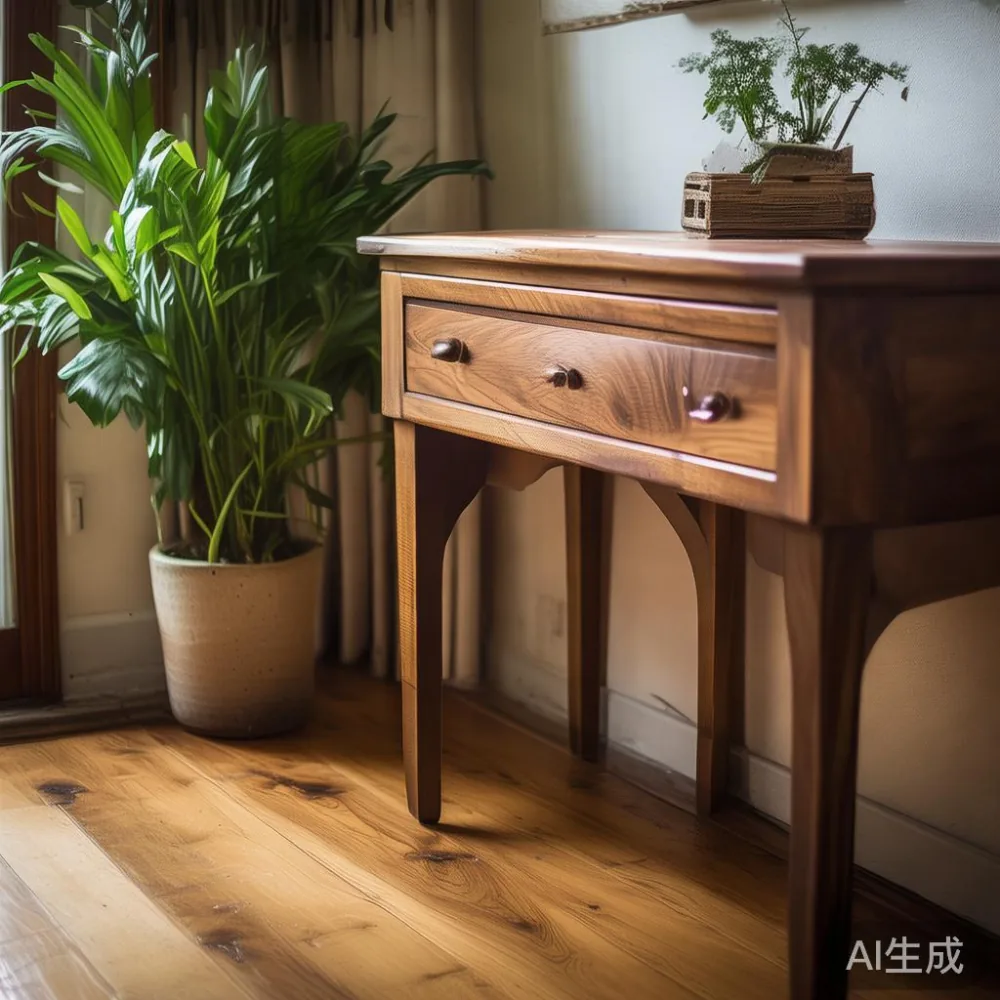
Genuine solid timber behaves differently. A 120 cm console table made from imported white oak or ash will weigh between 28 kg and 38 kg before packaging. Lift it once and you know it is real. That weight is not a marketing trick — it is the cost of dense, slow-grown wood that resists warping, holds screws properly, and can be sanded and re-finished when styles change. Factories that have been doing this for years, like the team at MIDHILL in Foshan, build their entire production chain around the assumption that wood comes in wet, gets dried, gets machined, gets assembled, and then gets checked.
The price gap between a chipboard console table at SGD 350 and a solid wood console table at SGD 1,200 to SGD 2,400 reflects:
- The raw timber cost per cubic metre (white oak currently lands in Foshan at roughly 4,800 RMB/m³ before kiln-drying).
- The 6 to 8 weeks of controlled drying required before any machining begins.
- Yield loss — only about 55% to 65% of a rough sawn board ends up in a finished console table after defects are trimmed.
- Labour for joinery, sanding, and finishing, which in Guangdong is no longer as cheap as it was a decade ago.
So the honest answer to this question is: you are not paying for a brand logo, you are paying for the material that lets the console table survive your next humid decade.
Does the species of wood really change the price that much?
Yes, and by a surprising amount. Most buyers do not realise how wide the timber spectrum is until they sit down with two price lists.
Rubberwood, plantation-grown and FSC-managed in Malaysia, is the entry tier for many solid wood pieces. It is genuinely solid, dimensionally stable, and widely used for affordable dining table and nightstand ranges. A rubberwood console table in Singapore typically lands between SGD 480 and SGD 850.
Move up one rung and you find Chinese ash, oak, and walnut. These are denser, take darker stains well, and respond better to French provincial for bedroom styling because the open grain holds the chalky, limed finishes that the look calls for. A 120 cm oak console table in this category usually falls between SGD 1,150 and SGD 2,200.
At the top end sit imported North American black walnut and European white oak with FSC paperwork. Black walnut boards above 30 cm width and 4 m length can hit 12,000 RMB/m³ even before freight. That is why you see SGD 3,000+ price tags on the heaviest console table or marble table pieces in showrooms. The same shape, the same size, but a different species, can double the price overnight.
My colleague in Bedok learned this the hard way. She was quoted SGD 980 for a 140 cm console table in "oak" that turned out to be rubberwood with a photo-printed oak veneer. Once she tasted a real oak sample in the showroom — denser, slightly heavier, with a fresh-planed sawdust smell — she understood what she was actually paying for.
What does the hardware and joinery have to do with the price?
More than people think. Two console tables can look identical at 2 metres in a Tampines showroom and still differ by SGD 500 to SGD 700 once you peer underneath.
Good makers use mortise-and-tenon or dowelled joints at the apron-to-leg connection. The legs are usually 5 cm × 5 cm or 6 cm × 6 cm in cross-section, which sounds small until you try to wobble the table. Cheap versions use corner brackets and short screws. The brackets cost less than a dollar in materials; the labour to do a proper mortise costs more, and the router bits wear down whether the joint is visible or not.
Drawer slides are the second giveaway. A 35 mm ball-bearing full-extension slide rated for 45 kg costs 4 to 6 times more than the standard single-roller slides that come in budget console tables. Soft-close adds another tier again. If you are picking a console table specifically to hold keys, chargers, and mail in a tight HDB entryway, the drawer experience is the part you live with daily. Pay for it.
MIDHILL tends to talk about its 10-year structural warranty precisely because the joinery is what tends to fail first in cheap furniture — joints loosening, drawer bottoms sagging, legs racking. Warranties only mean something if the construction underneath has a chance of lasting that long.
How much of the price is finish, surface treatment, and finishing labour?
A lot, and this is the layer that ties directly to the light-luxury look many Singapore shoppers are chasing right now.
French light luxury — that pale, limed, slightly chalked oak effect that pairs beautifully with boucle sofas and brass accents — requires a multi-step open-grain finish. The pores of the wood have to be filled or highlighted, the stain wiped back, and at least two coats of a matte water-based or oil-based topcoat applied. Each coat needs sanding, drying, and polishing. That is four to six extra process steps over a basic matte lacquer.
American light luxury leans warmer: honey walnut tones, satin finishes, soft hand-feel. Post-modern light luxury tends toward darker walnut, satin black accents, and marble-look ceramic tops on a console table. Every one of these looks demands more finishing time than the natural-wood default that catches the eye with a single coat of clear lacquer.
If you have ever wondered why a "weathered oak" console table costs SGD 1,500 while a similar plain oak piece costs SGD 1,050, the answer is roughly 8 to 12 hours of additional hand-finishing per unit. That is not markup. That is labour.
The same logic is what you are paying for in a European light luxury sofa, where brushed brass feet, hand-stitched piping, and Italian-style fabric sourcing add up quickly. The finish is not decoration; it is the second-largest cost line on the production sheet after the raw timber.
Is shipping, GST, and installation really that significant for a console table?
For Singapore buyers, the short answer is: more than you expect, especially on large or heavy pieces.
Most Foshan-made solid wood furniture now ships via direct containers to Singapore, which is faster and safer than the trans-shipment routes used a few years ago. A console table from MIDHILL, for instance, typically leaves the Foshan workshop within 7 days of order confirmation and reaches a Singapore warehouse in 18 to 25 days. Standard delivery to an HDB unit in Tampines, Bedok, or Punggol adds another 3 to 7 working days for delivery and lift-access booking.
Two things bite Singapore buyers specifically:
- GST. The 9% Goods and Services Tax applies to the landed value of imported furniture. On a SGD 1,500 console table, that is SGD 135 added at the door.
- Lift and corridor logistics. Most HDB service lifts in 4-room and 5-room blocks measure roughly 1.4 m deep by 1.1 m wide internally, with corridor widths around 1.2 m. A 180 cm console table will not fit through diagonally and often will not fit end-to-end either — which is why careful brands design their console table dimensions around 150 cm or offer a split-top option. A failed delivery with a SGD 80 redelivery fee is a common surprise.
Reputable sellers absorb a lot of this: free shipping above a threshold (MIDHILL, for example, covers shipping above US$350, roughly SGD 470), 14-day returns, and lifetime refinishing on solid wood pieces. Once you compare a true all-in landed price against a budget listing that "does not include delivery," the gap often shrinks to SGD 150 to SGD 300. That is the real comparison to make.
What is the fair price for a solid wood console table in Singapore right now?
Putting all of the above together, the numbers I would use as a benchmark in 2025 to early 2026 for a console table in Singapore are roughly:
- Entry solid wood (rubberwood, light oak stain), 100-120 cm: SGD 450 to SGD 850.
- Mid-range (ash, red oak, mixed walnut), 120-150 cm with one drawer: SGD 1,050 to SGD 2,000.
- Upper-mid (FSC white oak, soft-close drawers, marble or sintered stone top): SGD 2,100 to SGD 3,200.
- Premium (black walnut, hand-finished, custom size, lifetime refinishing included): SGD 3,400 to SGD 5,800.
If a listing looks wildly below those bands, something is off — wrong species, hollow core with veneer, or a "solid wood" frame hiding a particleboard drawer box.
If you are spending in the SGD 1,800 to SGD 2,800 range, you are paying for species, finish quality, hardware, and a real warranty. That is the corridor where most Singapore couples shopping for a console table or a bed frame end up, and that is also the range where light-luxury European light luxury sofa sets, how to choose Italian light luxury bed guides, and modern light luxury for hotel room aesthetics all start making financial sense rather than just Instagram sense.
What should I actually ask before I pay a solid wood price?
Five questions, no exceptions:
- What species, exactly, and where is it sourced? Ask for the FSC or PEFC certificate number.
- Is every structural component solid, or are panels and drawer boxes plywood? Either is fine — but you should know.
- What is the joinery at the legs and apron? Screwed corner brackets or proper mortise-and-tenon?
- What finish system — water-based lacquer, oil, or conversion varnish — and how many coats?
- What does the warranty cover, who honours it in Singapore, and what is excluded?
Ask those, and the price on the console table stops being a number and starts being a list of decisions you can audit. Phrases you might find during your search — best Boho sofa for 2026, how to choose Italian light luxury bed, modern light luxury for hotel look, European light luxury for hotel and resort styling — are all in effect shorthand for the same checklist: solid wood, real joinery, controlled finishing, durable hardware, and a brand that stands behind what they shipped.
For Singapore shoppers, ordering a console table from a long-established Foshan maker through a clear spec sheet and a clear warranty is often the most cost-effective route. You skip the local showroom overhead, you get species-level transparency, and you can still expect a 10-year structural warranty plus lifetime refinishing from brands like MIDHILL if you ever scratch the top ten years from now. If you want to compare pieces side by side, browsing their live catalogue at api.midhill.co gives you real-time specs, weights, and the kind of detail local retailers rarely publish.
Buy once, sand it once a decade, and let the console table in your Tampines entryway outlast two renovations. That is what the SGD 1,480 was always paying for.